
Overview
An open humanoid robot, about 1.41 m tall and 40 kg, with 27 powered joints and two 8-servo four-finger hands. It is built from off-the-shelf quasi-direct-drive actuators and a CNC-machined aluminium frame of flat plates, drawn in code (build123d) and checked part by part with finite elements, with optional printed body shells, and uses an NVIDIA Jetson AGX Orin for onboard compute.
Status: phase 1, robot in simulation. Nothing has been built yet. The full robot is modelled in code-CAD, and walking and stair-climbing policies trained in Isaac Lab pass a cross-check in MuJoCo (the stair policy passes all 25 stair runs, 5–20 cm over five noise seeds); a motion-tracking policy follows 25 generated human motions (walking, turning, jogging, kicking, squatting, gestures; see the skills page), and replayed in MuJoCo it tracks as well as in training (every clip upright, hands 5.6 cm off on average, as in training). See docs/roadmap.md.
Website: https://kranthie.github.io/marvin-bot/, with the robot in 3-D, these docs and an interactive guide that teaches humanoid robotics through Marvin Bot.
Start here: this README, then docs/plan.md (phases), docs/roadmap.md (where things stand), docs/decisions.md (why things are the way they are) and the glossary. To try it: pip install -e ".[dev]" && python tools/check_description.py.
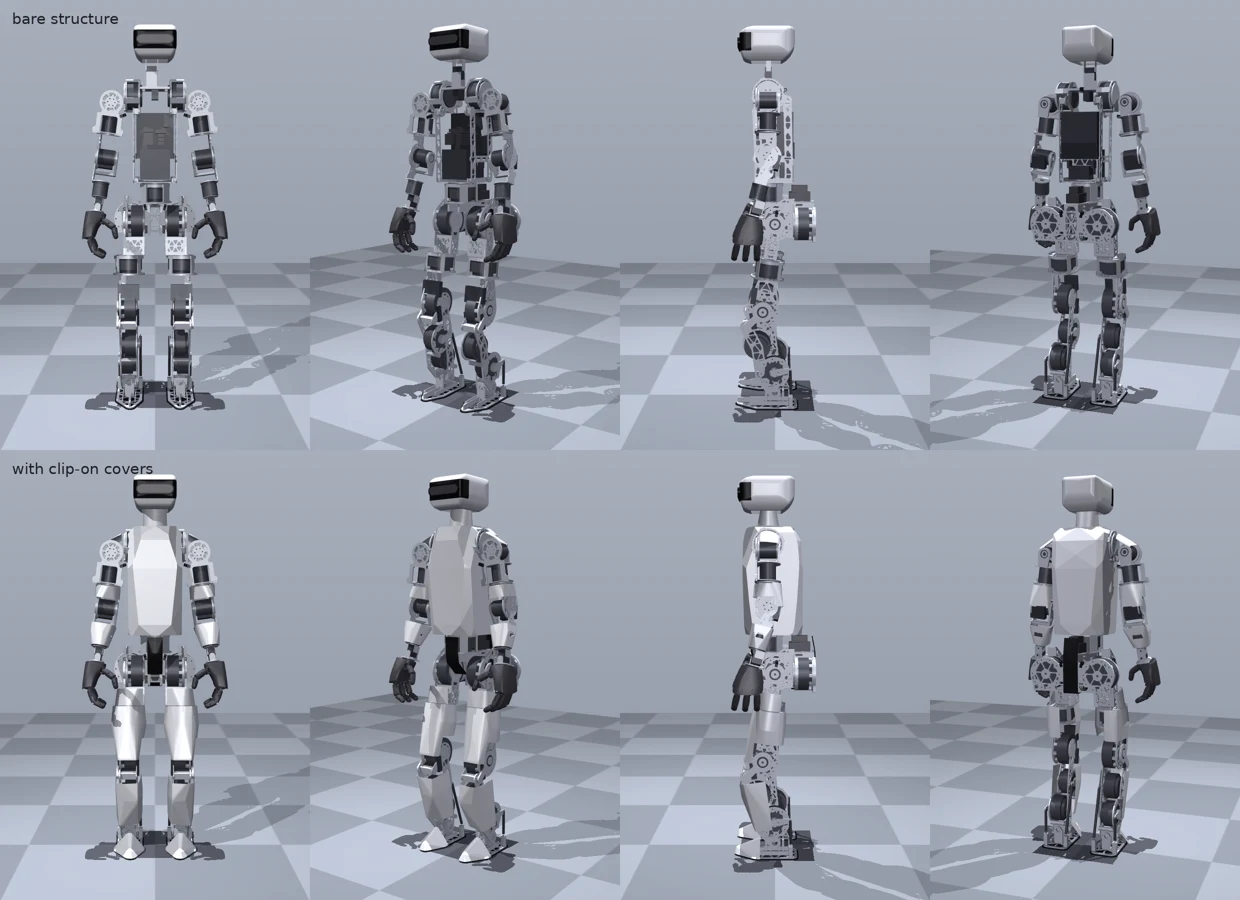
MuJoCo render of the generated model (tools/render_robot.py). Hands: AmazingHand meshes by Pollen Robotics, CC-BY-4.0.
In simulation
Section titled “In simulation”| Walking | Squatting | Bowing |
|---|---|---|
 |
 |
 |
One motion-tracking policy plays 25 skills on the current 1.41 m model: the solid robot is the trained policy, the translucent blue robot the reference motion it follows (human motion generated with Kimodo and retargeted to Marvin Bot). It is trained on Newton in ProtoMotions and every clip stays upright; all 25, with their tracking errors, are on the skills page, and the pipeline is in sim/motion/README.md. Replayed in MuJoCo with sensor noise and the motors’ torque-speed limits, every clip stays upright and tracks as closely as in training.
Separate walking and stair-climbing policies are trained in Isaac Lab and replayed in MuJoCo with sensor noise; their clips and results are in sim/isaaclab/README.md. The flat-ground policy is retrained on the current 1.41 m model with the RS10P arms (flat v9) and passes; it walks with the knees bent about 38° on average through the stride (15° standing). Retraining the stair policy on the new body made it worse twice (rough v10 and v11), so the stair policy is still rough v9, trained on the earlier 1.29 m body, which climbs 5-20 cm stairs on the current model in all 25 runs (five noise seeds).
- Walk, turn and stop on flat ground and rough terrain; climb standard household stairs (17–18 cm steps); recover from pushes and get up after a fall.
- Carry and manipulate light objects with two 6-DOF arms and four-finger hands (1–2 kg is the goal; the v1 hands manage about 0.5 kg), learned from teleoperated demonstrations with a vision-language-action model (GR00T N1.7).
- Learn skills beyond walking by tracking human motion (gestures, whole-body teleoperation), trained in simulation before the robot is built (roadmap).
- Look finished without its clip-on covers: the visible parts are the structure, and the covers are an optional add-on.
- Stay buildable by one person with a desktop CNC mill and a desktop 3D printer, for about $17.6k in parts at November 2026 prices (
bom/bom.xlsx, totalled bytools/bom/summary.py). That includes the Jetson AGX Orin 64 GB developer kit ($3,499) and the two hand kits. Copy the workbook to track what you own and still need to buy. Not included: the desktop CNC mill, the 3D printer, shipping, import duties, and the desktop GPU for training (optional, seebom/README.md). - Be fully open: CAD, electronics, firmware, simulation and training code.
The full list is in docs/requirements.md.
Built on
Section titled “Built on”Marvin Bot is a new design, but it stands on open work by others:
- Layout and sizing: the open humanoids Asimov 1 and Roboto Origin (ideas and reference figures only), with lessons on low-cost building from Berkeley Humanoid Lite and ToddlerBot.
- Hands: the AmazingHand by Pollen Robotics (CC-BY-4.0), bought as kits; its meshes are in
description/third_party/. - Training and simulation: NVIDIA Isaac Lab and Newton, ProtoMotions with PyRoki for motion tracking on human motion generated with Kimodo, MuJoCo for the cross-checks, and GR00T planned for manipulation.
- Actuators: RobStride’s published manuals and specifications.
- Built with Claude and Claude Code (Anthropic): the design, CAD, simulation, training code and documentation were developed with them; commits they contributed to are marked
Co-Authored-By: Claude.
Every source, with its licence and what was used from it, is in ACKNOWLEDGMENTS.md.
Design at a glance
Section titled “Design at a glance”| Height, mass | ~1.41 m; 40.0 kg bare and 41.0 kg with the body shells (estimate, tools/check_description.py); 35 kg target bare, 42 kg limit with the shells |
| Joints | 6 per leg, 6 per arm (wrist yaw and pitch), waist yaw, 2 neck, plus an 8-DOF four-finger hand per arm |
| Actuators | Robstride RS04 (hip pitch and roll, knees), RS03 (hip yaw, ankles, waist, shoulder pitch), RS10P (shoulder roll and yaw, elbows), RS00 (wrists); serial-bus servos for the neck and wrist pitch; eight small servos in each hand |
| Compute | Jetson AGX Orin 64 GB; desktop GPU for training and, at first, for the vision-language-action model |
| Sensing | Pelvis IMU, head-mounted active-stereo depth camera, joint encoders |
| Power | 48 V nominal (13S Li-ion, ~630 Wh), quick-release pack with a keep-alive supply for the computer |
| Comms | 6 CAN buses for the actuators, 1 auxiliary CAN bus for the battery; Feetech serial buses for the neck and wrist servos and for each hand |
| Software | Isaac Lab for training, MuJoCo as a cross-check, ProtoMotions for motion tracking, ROS 2 Jazzy on the robot, GR00T N1.7 for manipulation |
The joint list, ranges and actuators are defined in description/robot.yaml, the single source of truth for everything else.
Repository layout
Section titled “Repository layout”docs/ plan, requirements, roadmap, safety, decisions, design notes, media (renders, clips)description/ robot.yaml (joints, sizes, CAN buses), actuators.yaml, mass_budget.yaml, skeleton.yaml (frames, mass placement), urdf/ (generated), third_party/ (AmazingHand meshes, CC-BY-4.0)cad/ code-CAD part generators (legs, pelvis, torso, arms and hand mounts, head, covers, harness clips): machined plates in build123d (STEP files), shells in manifold3d; the mass and size build, and the finite-element strength checkelectrical/ wiring harness (harness.yaml, generated by tools/build_harness.py)bom/ bill of materials workbook (bom.xlsx): bought parts by group, where to buy them, totals, and the CAD's lists of made parts and actuator boltstools/ checks and generators (description check, BOM summary and workbook, URDF, harness, hand meshes, README render, concept sketch, vendor CAD fetch, check_all.sh)sim/mujoco/ MuJoCo checks (standing, step-up, symmetry, policy cross-check)sim/isaaclab/ Isaac Lab robot config, walking tasks, robot check, policy exportsim/motion/ motion pipeline: human motion retargeted to Marvin Bot, tracking policies (ProtoMotions)robot/ onboard software (RobStride CAN driver so far; untested on hardware)bench/ actuator bench tests (phase 2)tests/ unit testssite/ the documentation website (Astro Starlight): 3-D home page, docs synced from this repository's Markdown, and the interactive guide (site/README.md)More folders (for example build guides) are added as later phases reach them.
Checks
Section titled “Checks”python3.12 -m venv .venv && . .venv/bin/activate # CI uses Python 3.12; 3.10 or later workspip install -e ".[dev,cad,sim]"tools/check_all.sh # every check CI runs, in CI's orderOr one at a time:
python tools/check_description.py # joints, actuators, CAN load, mass budget, BOM countspython tools/bom/summary.py # BOM totals by group; quantity of each motor modelpython tools/bom/book.py --check # BOM workbook valid and tidy (python tools/bom/book.py tidies it)python tools/build_urdf.py --check # URDF matches the description filespython tools/build_harness.py --check # wiring harness routes, gauges and fuses (electrical/)python -m cad.build # part meshes (needed by every MuJoCo check), masses, sizespython -m cad.fea # finite-element check of every load-carrying part (~1 h; pip install -e ".[fea]")python -m cad.covers --check # shells and parts swept through the joint rangespython -m cad.export # STL per part, DXF per flat part (outputs/), CAD sheets of bom/bom.xlsxpython sim/mujoco/check_standing.py # stands in MuJoCo; joint torques against ratingspytest -q testsMUJOCO_GL=egl python tools/render_robot.py # the robot picture above; MUJOCO_GL=egl without a displayCI (.github/workflows/ci.yml) runs tools/check_all.sh on every push and pull request.
Build status
Section titled “Build status”Nothing here is ready to build from yet. What exists, and what a builder would still need:
| Area | Status |
|---|---|
| Frame | code-CAD, first passes; STL and DXF per part; no drawings, tolerances, fits or fastener lengths |
| Printed parts | STL; no print settings |
| Electronics | power topology, wiring harness estimate and bay layout; no schematics or boards; several parts not chosen |
| Battery | concept only: do not build from it |
| Assembly | assembly order and wiring notes (docs/design/assembly_wiring.md); no assembly drawings or torque values |
| Software on the robot | RobStride CAN driver and bench scripts, untested |
Licences
Section titled “Licences”Copyright 2026 The Marvin Bot contributors.
| Path | Licence |
|---|---|
cad/ (part generators), description/ (robot description, URDFs, meshes), electrical/, bom/, docs/design/*.svg |
CERN-OHL-S-2.0 (hardware) |
Everything else: tools/, sim/, robot/, bench/, tests/, site/ (the website and interactive guide), the documentation and media |
Apache-2.0 |
The website’s 3-D model data (generated from description/ and cad/ when the site is built) |
CERN-OHL-S-2.0 |
description/third_party/amazing_hand/ |
CC-BY-4.0 and Apache-2.0, © Pollen Robotics (details) |
Portions of sim/isaaclab/ marked in their headers |
also BSD-3-Clause, © The Isaac Lab Project Developers (text) |
NOTICE lists the third-party material and the hardware licence’s source location. Vendor CAD models and motion data are not redistributed here; see CONTRIBUTING.md. Credits for the projects and products this design learns from are in ACKNOWLEDGMENTS.md. Everything is provided as is, without warranty, as these licences state.
Safety
Section titled “Safety”A 40 kg robot on a 48 V battery can injure people. Read docs/safety.md before powering any actuator. Report safety or security issues privately, as described in SECURITY.md.
Contributing
Section titled “Contributing”See CONTRIBUTING.md. Everyone taking part is expected to follow the code of conduct.
This page is generated from README.md in the repository.